
A couple of years ago, Malta seemed to be the place that all the travel bloggers were raving about. It’s also just one of those intriguing places that, unless you’ve been there, most people don’t know very much about.
I’m lucky enough to have spent a couple of good stints in Malta now. So, does it live up to the hype? Here are the things I loved about Malta, a couple of things I didn’t love so much, and what sort of trip I would recommend it for.
Valletta and the Three Cities


The first thing you need to know is that Valletta, Malta’s capital, is almost entirely a UNESCO-listed world heritage site. It’s one of the largest and best-preserved medieval old towns in Europe, and also one of the most densely packed historic areas in the world. This tiny island sits at an important strategic point in the middle of the Mediterranean, and if you look at it on a map you’ll see why it made such a great harbour.
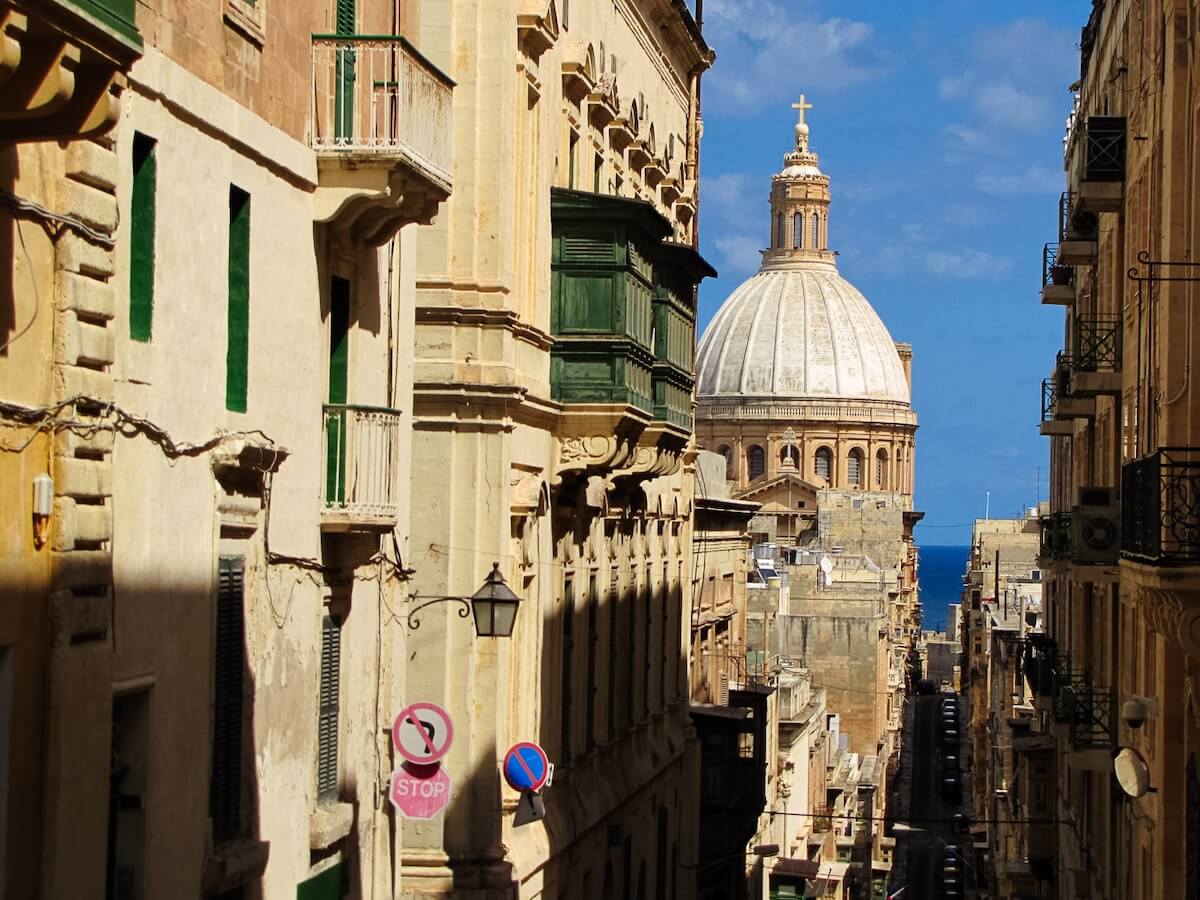
Valletta is chock full of beautiful golden-hued limestone buildings with ornate woodwork, Baroque churches, and impressive Crusader fortifications. It’s a photographer’s dream.
It’s also one of the smallest capital cities in the world. But Valletta is just one small area of a densely packed urban area. In effect, it functions like the Old Town of a wider city.
Valletta looks particularly amazing from the water – boat trips are the best way to fully appreciate the fortifications, and how unspoiled and unchanged the medieval area is.
You can also get cheap local water taxis over the bay from Valletta to the Three Cities (Vittoriosa, Senglea, and Conspicua), which are quiet and beautiful historic neighbourhoods to walk around. In fact, these neighbourhoods are even older than Valletta. They have two different names so you might also see them called Birgu, Isla, and Bormla. Most cruise ship visitors stick to Valletta so this is a great place to escape the daytime crowds. There’s a fast water taxi from the harbour at the bottom of the Barakka Lift in Valletta, or you can also hop on one of the traditional wooden boats for a similar price (they’re a bit like Malta’s version of a gondola – but much cheaper – and you can also take a tour of the bay on one).
The Neolithic Sites

Malta’s epic historic sites don’t end with Valletta – it has some really cool Prehistoric sites. I sometimes find that Prehistoric sites can be a bit hard to connect with if you don’t have a particular interest in the history, or a really good guide, but some of Malta’s sites give me the could-be-in-an-Indiana-Jones-film feeling.
The big one is the Ħal Saflieni Hypogeum, a Neolithic burial complex (also UNESCO-listed) not far outside Valletta. It was in use between 4000 and 2500BC – that makes it older than the Pyramids. You’ll have to be organised if you want to visit – it’s subject to capacity limits and tickets sell out in advance (there are a few walk-up tickets but they’re veeery expensive).
The other site I really enjoyed was Ħal Tarxien, a complex of temples that were originally (most likely) used for animal sacrifice. Like many of the Neolithic sites on Malta (the other ones being Ħaġar Qim and Mnajdra), it has intentional sun alignments – most notably when the first rays of the sun in the Summer Solstice line up with inner doorways. It also has ‘oracle holes’ that the priests would have used to amplify and change their voice.
Riviera Beach

Malta doesn’t have a huge number of beaches (I’ll get to this later), but the best beach on the island is undoubetdly Riviera Beach (easier to pronounce than its official name Għajn Tuffieħa). It might even be one of my favourite beaches ever – I just love the wild feeling of the landscape here.
It’s in the north of the island, not far from Golden Beach/Bay which is home to a few big hotels, and you can get a bus here directly from Valletta – but there are 200 steps down to reach the beach.
It’s not developed at all, except for the beach bar at the far end called Singita, which also has showers. And at the top near the road there’s a coffee/drinks trucks – the hazelnut iced chocolate milk was amazing, I definitely recommend. Stay for sunset and grab some food at the beach bar.
The sand here is fine and a beautiful red-gold colour. There are no sun loungers or other organisation, but there are lifeguards in the summer. During spring, the hills behind are carpeted with wildflowers. The Maltese coast is so busy, I was surprised to find completely undeveloped beaches. There are trails around the beach and if you head south you’ll reach the even wilder Qarraba Bay then Gneja.
Be careful swimming though – it’s exposed to the northerly winds and can get a bit wavy with strong undertow. And in the summer, of course, you can expect it to be very busy.
If you’re going to Gozo, then Ramla Beach has a similar look.

Gozo

Malta is technically an archipelago country, and Gozo is the other main island. Really, it’s Malta in miniature, a little sister over the water. It’s got a slower feel than the main island, much less concrete (although it pops up in places). Most visitors to Gozo are here for the walking and history. You can get day tours from the main island, including two Hop-On Hop-Off routes which include the ferry over from Malta.
Coastal Scenery and Boat Trips

What Malta lacks in beaches, it makes up for in boat trips. It has a lot of rugged coastal scenery with caves and rock formations best explored by boat. With Valletta and all of the coastal towns being harbour areas, there’s no shortage of launch points for boat trips.
The most popular boat trip on the island is to the uninhabited island Comino, which lies in between Malta and Gozo and is home to the famous Blue Lagoon. The shallow water is a dazzling shade of turquoise and makes for a memorable swim spot. Just know that there’s not really much else to do there aside from a short walk around the island if it’s not too hot. There are toilets, and a few food trucks selling pizza, baguettes, burgers, and cocktails, but that’s it. If you’re not travelling in the summer then a short stop is fine – some itineraries also call at Gozo or the Blue Caves.
The other boat trip worth taking is in the south of the island, to St Peters Pool. If you happen to be in Marsaxlokk or Marsaskala, then you can hop on a traditional luzzu boat for a cruise.
Unfortunately the Azure Window on Gozo (the location of Daenerys’ wedding to Khal Drogo in Game of Thrones) collapsed in 2017, but some other sites to check out are the Blue Grotto, the caves at Coral Lagoon, the boathouses at Daħlet Qorrot and Dwerja, the Dingli Cliffs, and the saltpans outside Marsaskala, Marsalforn, and Sliema.
Mdina and Rabat

If you enjoy the quiet limestone streets of the Three Cities, you might want to check out some of the historic inland towns.
Mdina was the original capital of the island; it was changed to Valletta in 1571 after the island survived a major attack by the Ottomans. There’s been a settlement here as far back as 4000 years ago.
These days Mdina is known as the Silent City, not just because it has a population of just a few hundred (most residents live outside the city walls in the area called Rabat) but because it also has strict noise rules.
It was one of the key filming locations for Game of Thrones, where it served as King’s Landing in the first season (before filming moved to Croatia for the later seasons). You do feel like you’re wandering around a film set inside Mdina – the architecture is pristine. Mdina has dungeons, and in nearby Rabat you’ll find extensive catacombs. If you’re a GoT fan you should also check out St Dominic’s Priory and the nearby San Anton Gardens. If you’re looking to stay overnight, I’d probably pick Rabat over Mdina as there’s a bit more life and plenty of good restaurants.
It’s Easy to Get Around

I’m a determined taker of public transport because I hate stress of renting and driving a car abroad, and I’ve got to say that Malta is one of the easiest places to get around by bus.
It helps that it’s a small place, and you’re likely to be staying in or near Valletta. But the main tourist areas are well served by buses, they’re reliably regular, and you can use Google Maps. The main bus station just outside Valletta is central and easy to navigate. Multi-day passes are available. Airport buses run almost through the night.
There are water taxis in some areas too, and the Hop On Hop Off Buses which run several different routes around Malta. These are really useful if you want to to see a lot on the island in a short amount of time without backtracking to Valletta to change bus.
That’s a pretty solid list of positives. But what about the negatives?
The Food


I’m a big foodie and trying local cuisine is one of the things I enjoy most when travelling. It’s not that the food in Malta is bad, per se, I just didn’t really have much memorable food. The only place I’d recommend off the top of my head is Munchies in Mellieħa (pictured above).
The easiest local dishes to find are pastizzi – flaky pastry shells filled with ricotta or mushy peas. And I do like a pastizzi (pastizzo?), but I can’t eat them every day. The bakeries are great for savoury stuff. It does seem like the Maltese like their fried items, which unfortunately means the whiff of cooking oil is often in the air, especially in tourist zones which are full of fast food.
In general, you’ll find lots of Italian restaurants – pizza and pasta are ubiquitous and the easiest food to find when out and about. And there are some great higher-end restaurants. But it’s not like Italy where you can walk into almost any restaurant and eat exceptional local produce. Eating well here requires a bit of research.
If you prefer international cuisine and casual dining, then Sliema and St Julian’s are the best areas for that, although they didn’t have as many restaurants as I expected. And Marsaxlokk is known for its seafood restaurants.
The Vibe

So the main trouble I have with Valletta (and this is entirely subjective, I know) is that whilst it looks incredible, and has incredible history, for me it doesn’t deliver on vibe.
Italy is heaving with similar-looking sandstone medieval towns with much more atmosphere. In fact, maybe this is part of its problem. It looks like Italy, but it doesn’t feel like Italy. I think the Brits might have ruined it, I’m sorry. If you happen to arrive on a rainy day, you could as well be in Glasgow city centre. There was even a Debenhams until 2021. Perhaps if you don’t go with expectations that it’ll feel anything like Italy, then it’s fine.
The wider Valletta urban area is a vast sprawl of concrete apartment blocks. There’s been a huge boom in construction and immigration over the past decade – it’s an international hub for online gaming and gambling. It reminds me now of the Spanish Costas with its built-up coastline and the distinct aroma of dodgy money. That’s not to say it’s unsafe (as long as you stay away from shady stuff). I felt very safe walking around as a solo female, although the St George’s Bay end of St Julian’s is a bit sleazy.
Don’t get me wrong, there are some really nice little corners and things to discover in the quieter areas, but it’s not a place that I fell in love with on arrival.
Is Malta worth it for a city break?
I do think it’s a cracking destination for a city break, especially if you like history and exploring. The best way to do it is to stay in Valletta or the Three Cities and, if it’s in your budget, book a nice hotel with a rooftop pool like The Embassy Valletta, IBB Hotel Palazzo Bettina Malta or The Gomerino.
If you prefer places with atmosphere and want to know where I’d go instead, I’d say Sicily (especially the Val di Noto), Puglia (Lecce), Dubrovnik, Corfu Town and Rhodes Town all check similar boxes but with a more enjoyable atmosphere. And Mallorca has a beautiful city but the island is infinitely better for scenery and beaches.
Is Malta worth it for a beach break?
If you’re thinking of Malta for a beach break, just know that there aren’t a huge number of beaches on Malta compared to other islands and areas in the Mediterranean (same for Gozo). Most of the coastline is rocky, and there aren’t really any small and charming beach areas. Personally, I prefer Malta as a city break with the occasional boat trip or day at the beach.
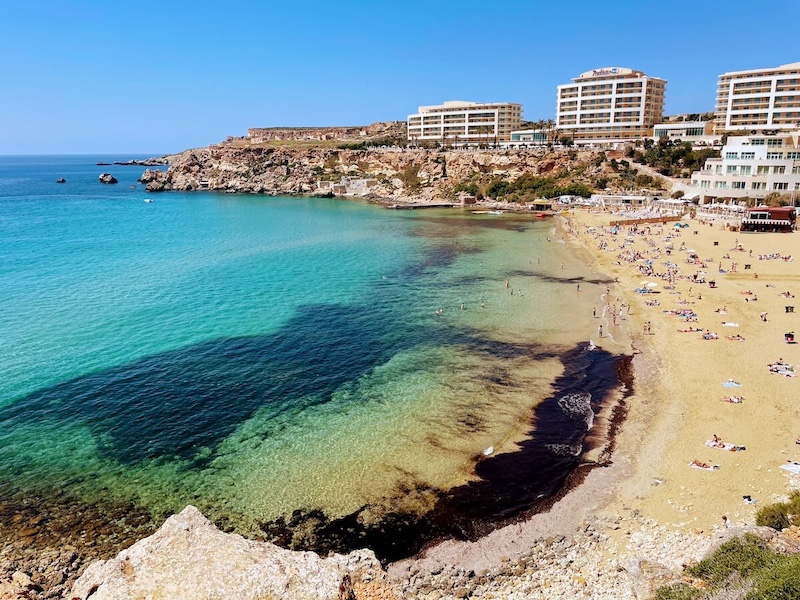
All of the resort areas are purpose-built and full of apartment blocks. Mellieħa is the best of the bunch and it does have a long sandy beach (albeit a narrow one with a road running behind it), plus it’s near to most of the other great beaches like Riviera, Golden Beach (pictured above), and Mistra Bay, as well as Popeye Village.
The busy urban areas Sliema and St Julian’s are also popular places to stay. It’s not really my vibe, but if you’re used to city hotels and the big resorts on the Spanish Costas then you might like the vibe here. It’s buzzing in the summer, with lots of parties, bars, and boat trips.
To sum up, am I glad I’ve been to Malta? Yes, definitely. Would I go back? Sure, but I’m not sure it would my first choice unless I find spectacularly cheap flights. Just don’t expect it to feel like Italy.
Read more:
Where to Stay in Malta: Ultimate Resort Guide
All images © The Mediterranean Traveller