
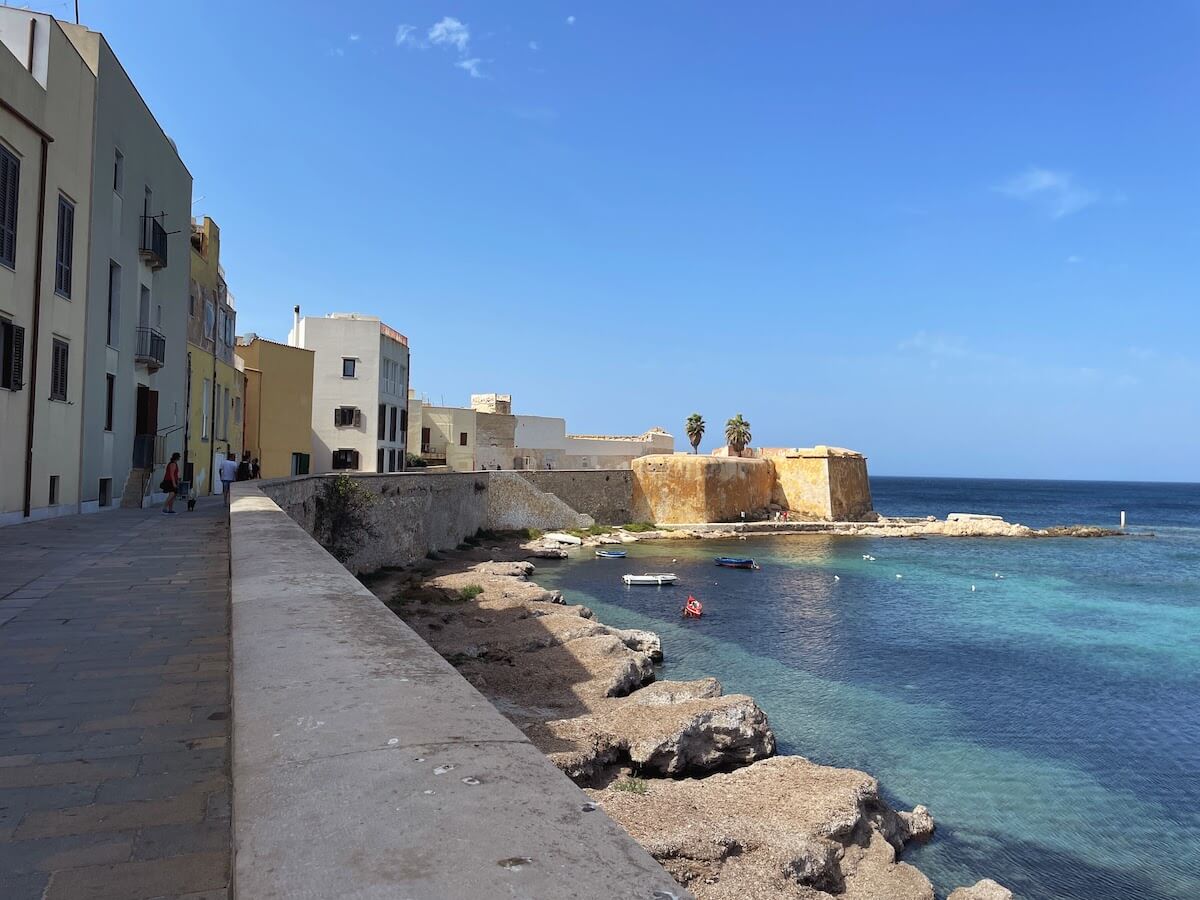
Trapani is a small port city in northwest Sicily with around 70,000 residents.
It’s not one of Sicily’s big-name tourist destinations. In fact, you’d be forgiven for never having heard of it. But Italian tourists are in the know and European budget airlines are increasingly flocking there, opening this overlooked part of Sicily up to tourism.
Here’s a quick guide to what you can expect from a trip to Trapani.
Where is it?
Trapani is on the north west coast of Sicily, between Marsala and San Vito Lo Capo.
It’s west of Palermo, the drive takes 1 hour and 30 minutes on good roads.
What’s the vibe like?

Trapani is a laid-back little city. If you find Palermo altogether too chaotic then Trapani might be for you. It also makes a really great base for exploring the highlights of the western side of Sicily.
It’s a working port that also has a university and a small historic centre. For exploring, it’s small and manageable with just two or three main streets of cafes and restaurants (although it’s worth exploring further afield, especially for food).
The old quarter is sleepy in the afternoon and comes alive in the evening at spritz o’clock.
One of the big pluses is that you can stay in the middle of the old town and have a surprisingly good beach in 2 minutes in one direction and the ferry port (to whisk you to the charming Egadi Islands) in 2 minutes in the other.
The scenery around these parts is dusty and flat, punctuated by steep limestone hills and vast salt pans.
For somewhere that’s a bit off-the-beaten-track, I was surprised at how well-organised the tourism infrastructure here is. I found it one of the easier places in Sicily to navigate with English. Information plaques are in English. The ferries and buses are easy to use. Tours are easy to come by.
There’s even a strange trend of vending machine stores in the centre if you need a bottle of water at an odd time.


What to see and do

Trapani is the kind of place you can sit and soak up the atmosphere, admiring your surroundings. Taking a stroll along the north side of the city (next to the beach) at sunset is practically a requirement.
But there are also a few notable buildings worth checking out. Red information signs with text in both Italian and English are helpfully located throughout the city.
One of the first landmarks you’ll come across is the Torre dell’Orologio, an ornate facade on an old bank building with a number of clocks. It sits at the end of Corso Vittorio Emmanuele, one of the main tourist streets.
The 16th-century San Lorenzo Cathedral is also on this street and it contains some fine religious art.
But the most important building to visit is the Chiesa dell Anime Sante del Purgatorio, the home of the Procession of the Mysteries of Trapani.
You might not have heard of this if you’re not Italian, but Trapani is home to one of Europe’s longest Holy Week processions. Called the Misteri, it’s been running since at least 1612 and is somewhat similar to Semana Santa (and in fact a legacy of Norman rule in the area). Twenty floats containing artistic representations of the Passion are carried around the city by members of its guilds for the best part of the day. The floats are displayed inside the church.

If you’re a fan of art deco interiors, do pop into some of the city’s municipal buildings (such as the Post Office) which sport some impressive interiors.
Take a wander to the quiet far western end where you’ll find the Torre di Ligny which has a small museum of local relics, and some rocky swimming platforms. If it’s not too windy you can walk to the Lazzaretto – a small island accessible by causeway which was once a quarantine station. It’s now surrounded by yacht pontoons.
For something a bit more lighthearted, there’s the Museum of Illusions for taking creative selfies.
Keep an eye out for the lovely Fontana di Saturno in the piazza outside the Chiesa di Sant’Agostino.

Activities and Amenities

Trapani Food Tour is a great way to explore the streets and tastes of the old town. It starts at 6:30 pm and lasts for 3 hours, I highly recommend booking this for your first evening – it’s a great introduction to the city.
There’s a guided Salt Flats group tour which includes the Salt Museum and will also stop at flamingo-sighting points when they’re around. It takes just two hours. I had never really stopped to think about how they make salt before but it’s a fascinating process. A must for foodies.
There are numerous travel agencies near the ferry port and bus stop which can help you with excursions and information as well as bike rental, bus tickets, and luggage storage.
If you prefer to explore under your own steam then it’s possible to reach Agrigento and Marsala by bus.
But by far the most popular things to do in Trapani are to visit the popular medieval hilltop town Erice and the beautiful Egadi Islands. These are 3 small inhabited islands which are connected by regular ferries.
There’s a cable car which will transport you up to Erice in just 10 minutes. Unfortunately, the cable car is on the outskirts of town (a bit too far to walk – about an hour) but you can take the bus from Piazza Vittorio Emmanuel (lines 21, 22, 24, 201 and 203) – check the website for more information.
I was seriously impressed by how easy it was to visit the Egadi Islands. The main draw is the island of Favignana which is known for its immaculate turquoise water. It has a few sandy beaches and also plenty of rocky areas and cliffs for jumping.
Favignana has a relaxed youthful vibe going on – it’s the kind of place I could easily end up staying for a week. But even if you’re only in Trapani for a short time it’s worth a quick visit. The ferry can take as little as 25 minutes and you can rent a cheap bicycle on arrival which will take you around the island in a few hours.
There are also many excursion boats which will take you to one or more of the islands. These are ideal if your priority is visiting the best swimming spots. Here’s an example of an excursion boat.
Make sure you check where they leave from when you buy your ticket as the day boats are a short walk further down the port from the Egadi ferries.
Read more: How to Visit Sicily’s Egadi Islands
What’s the beach like?

Trapani’s north side is blessed with a dazzling sandy beach right underneath the city ramparts. It makes for a memorable swim,
The beach itself is narrow and due to its location is sometimes shaded. You can wade out for a long way in shallow waters.
Unusually for an Italian beach, it’s completely unorganised. It’s probably not the kind of place you’re going to stay all day, but for an afternoon swim it’s great. After the old marketplace, it becomes too narrow for bathing, although you’ll find people camped out on the rocks with their towels. If you want to spend all day at the beach it’s worth heading further out of town to:
- Lido Paradiso – the nearest beach club to the city, on a breakwater beach. There’s a free beach opposite.
- Spiaggia di San Giuliano – a big sandy beach, much wider than the city beach, and with lidos (beach clubs) along its length. It’s about 1 hour on foot but you can take a bus (line 21) or rent a bicycle.


How to get there?
Trapani-Birgu Airport is a small international airport which is served by Italian carriers and some European budget airlines. I flew there from London Stansted with Ryanair (who seemed to rename it Trapani-Marsala), however, routes are inclined to change from year to year.
I recommend using Skyscanner to check routes and fares.
It’s also an easy journey from Palermo by car or bus.
How to get around

From the airport:
Buses connect the airport with Trapani as well as Palermo and Agrigento – check the website for more information. The Trapani buses are run by AST and are hourly.
I paid €34 for a taxi from the airport to the ferry port during the daytime on the meter. Some of the streets in the old town are pedestrianised so you might not be able to drive right up to your hotel.
Public transport:
The bus stop that you’re most likely to use is right next to the ferry port. This is where the airport bus terminates, as well as AST who serve Palermo and other longer routes.
You can ask the travel agency located here for any information you need. They sell tickets for the airport and Palermo but not smaller local routes where you pay the driver on board.
If you’re planning to get local buses I would caution that many of these are scheduled for the same time (e.g. on the hour) and most serve local schoolkids who live in the villages outside Trapani. The result is 5 buses arrive at one’s and there’s a scrum to get on them. So it can be chaos, and as a tourist, you will have the last priority to get on these buses. I did meet one couple who completely missed their bus in the mayhem.
Trapani also has a train station just outside the old town. The line runs down to Marsala and Mazara del Vallo then back up to Palermo via Castelvetrano.

Ferries to the Egadi Islands are run by Liberty Lines. There’s a small modern terminal next to the bus stops which has toilets and a cafe.
At busy times you will want to book ahead, especially if you’re doing a day trip to Favignana and want to return in the evening. I recommend using Ferryhopper for checking times and routes and purchasing tickets (the app is really easy to use and it’s what I personally use for most of my ferry journeys).
To give you an idea of the costs, a single ticket between Trapani and Favigana was €13. It’s possible to visit more than one island in a day.

Accessibility:
Trapani is mostly flat and the historical centre is small and paved with flat square stones. The quality of the paving drops outside the old town. Most of the buildings are tall apartments around a courtyard which are unlikely to have lifts, it’s best to look at the hotels just outside the old town which are more modern.
Steps are required to access the main city beach however some of the beaches in the surrounding area offer inclusive amenities – read more.
The biggest and most central car park is at Piazza Vittorio Emmanuel.
Prices

You can expect average tourist prices in Trapani’s old town. It’s small so there isn’t enough competition to bring prices for food or accommodation down, as you might see in Palermo. But if you venture outside the historic centre you can find some cheaper prices.


Don’t leave without trying . . .

The local dish is busiate alla Trapanese, a squiggly pasta served with a sauce made with almonds, tomatoes, garlic, and basil. I tried it at several places and the best I had was at Angelino’s near the ferry port (which is also a cafe and bakery as well as a restaurant).
Skip the pizza and head straight to the seafood section of the menu. Red prawns (gambero rosso) are a local delicacy which you can eat raw and you’ll find them in delicate salad or ceviche dishes.
Spritz is big business here as you’ll see when you walk the main streets. I particularly enjoy a Spritz Siciliano which contains a bit of orange juice. There’s also a local version with Amaro.
The best arancine I had was at Ferlito’s near the Torre dell’Orologio. If you need a snack in the afternoon this place is a good shout as many establishments close until aperitivo time.

Where to stay
You won’t find any swanky luxury hotels in Trapani, instead, look for charming guesthouses. The good places do book up quickly.
Top pick is Dimore Botteghelle which scores points for its sympathetic renovation and delicious breakfast.
4-star Palazzo Gatto is a boutique hotel with modern neutrals and a rooftop jacuzzi.
Ai Lumi is a popular guesthouse with historic charm right on Vittorio Corso Emmanuel.
Central Gallery Rooms is a 3-star with modern sea view rooms in a converted palazzo with a lovely courtyard.
Read more:
Where to Stay in Sicily: Ultimate Beach Resort Guide
10 Most Beautiful Beaches in Sicily
Image credits: All photos © The Mediterranean Traveller