

If you’ve never heard of Trapani then you might not be aware of the many great reasons to fly to this under-the-radar city on Sicily’s northwest coast.
The airport is officially named Trapani-Birgu but you might see it referred to (here’s looking at you, Ryanair) as Trapani-Marsala. An astute marketing ploy because Marsala is the most well-known town in the area thanks to its wine. The airport is actually closer to Marsala than it is to Trapani.
There’s a whole host of wonderful things to do in this region, where the tourist footfall is so much lower than on its opposite coast.
So here are 7 reasons you should consider flying into Trapani-Birgu International Airport.
Trapani is a laid-back gem

Trapani is a small port city with a historic centre and a surprisingly good white sand beach with temptingly shallow waters that sits at the bottom of its old walls.
It’s a university town and so has a relaxed buzz about it. There are few big attractions and the old quarter is small but it’s a great place for a laid-back base. You can sightsee or sunbathe during the day and take your evening spritz overlooking the water. It’s a world away from chaotic Palermo.
The ferry port here is the main hub for reaching the beautiful Egadian Islands (more on those later).
Read more: A Quick Guide to Trapani
Erice is just up the hill
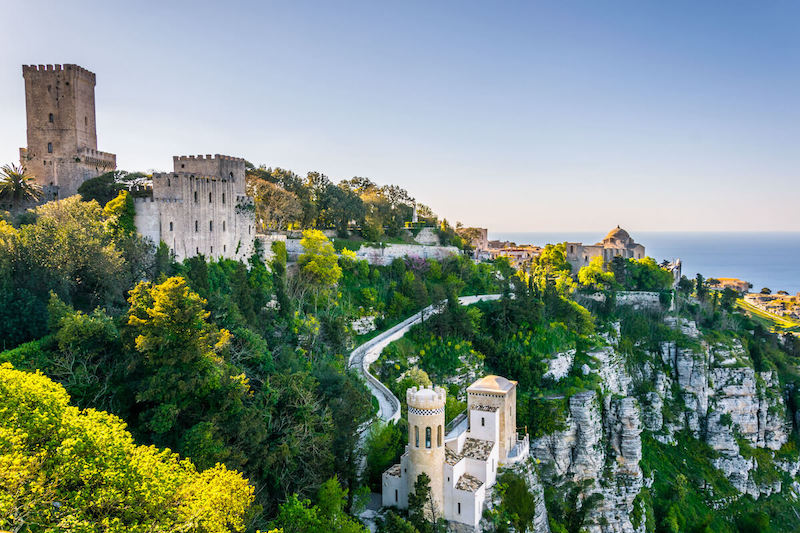
One of western Sicily’s most iconic tourist sites is the beautiful medieval hilltop village of Erice. And it’s literally just up the hill from Trapani.
Luckily you don’t have to walk, there’s a cable car which will whisk you straight up. It’s on the outskirts of Trapani so you’ll have to hop on a bus from Piazza Vittorio Emmanuel (lines 21, 22, 24, 201 and 203) to reach it.
There’s little to do here but wander the romantic streets and the ramparts of 12th-century Norman castle (currently under renovation) so you probably wouldn’t want to stay overnight.
But do grab a sweet treat from Pasticceria Maria Grammatico, a much-loved local bakery.
These limestone karst mountains are typical of northern Sicily but the landscape flattens out south of Trapani, where you’ll also find fewer tourists.
It’s really easy to visit the Egadi Islands
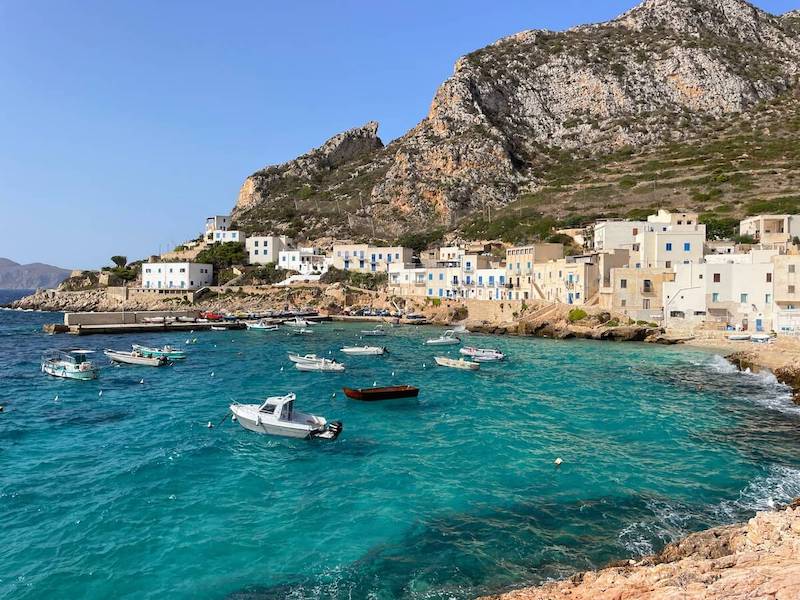
The Egadi (or Egadian, or Aegadian) Islands had long been on my Mediterranean bucketlist so I was delighted when Ryanair started flying to Trapani from my local airport as it meant I finally had a reason to visit.
There are 3 inhabited islands in this small group a short distance off the coast of Trapani – Favignana, Levanzo, and Marrettimo.
Favignana is by far the most popular as it’s the biggest and has a beautiful coastline of rocky platforms and sandy beaches. Many visitors hire a bike on arrival to cycle around the island.
Levanzo and Marettimo are both much quieter and home to whitewashed buildings with blue doors and shutters that wouldn’t look out of place on a postcard from Greece. The sea is a dazzling shade of turquoise.
I had no idea how easy it was to island-hop around here. The ferries are fast and frequent, and the ferry port is right next to Trapani old town.
The region has incredible ancient sites
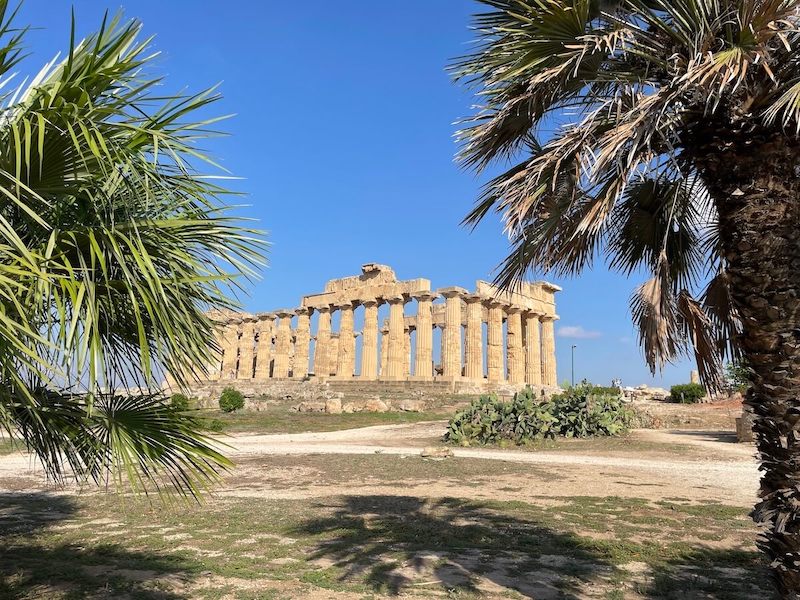
The west of Sicily is home to some magnificent ancient sites, including the highest number of Greek ruins outside Greece.
The closest is the Temple of Segesta which is a 25-minute drive. If you’re driving back to Palermo then it’s on the way.
Selinunte (pictured above) is on the south coast, 1 hour’s drive from Trapani. It’s the largest archaeological park in Europe and has a magical setting right by the sea.
Agrigento, the most famous ancient site in the area, is also by the sea on the south coast. It’s a bit far for a day trip as it will take 2 hours by car but it’s worth it to see the Valley of the Temples.
Public transport is unfortunately limited but there is a bus between Trapani and Agrigento, and if you check in at any of the local travel agencies they’ll let you know about possible excursions to Segesta or Agrigento.
The beaches are stunning

They haven’t yet been discovered by the international masses but the beaches in this part of Sicily are fantastic – long and sandy with shallow seas.
To the north of Trapani is San Vito Lo Capo (pictured above), one of the most popular beach resorts in Sicily and known for its huge white sand beach.
As well as the city beach in Trapani, you can head north just outside the city to Spiaggia di San Giuliano where you’ll find a wide beach with plenty of lidos (beach clubs).
Favignana has a couple of sandy beaches.
Between Trapani and Marsala, the coastline is taken over by salt flats which have an eerie beauty all of their own and are well worth exploring, but you’ll still find it punctuated by sandy beaches. Keep going though as the south coast beaches are arguably the best of all (especially if you like wild sandy beaches).
Read more: A Quick Guide to San Vito Lo Capo
The wine is fantastic
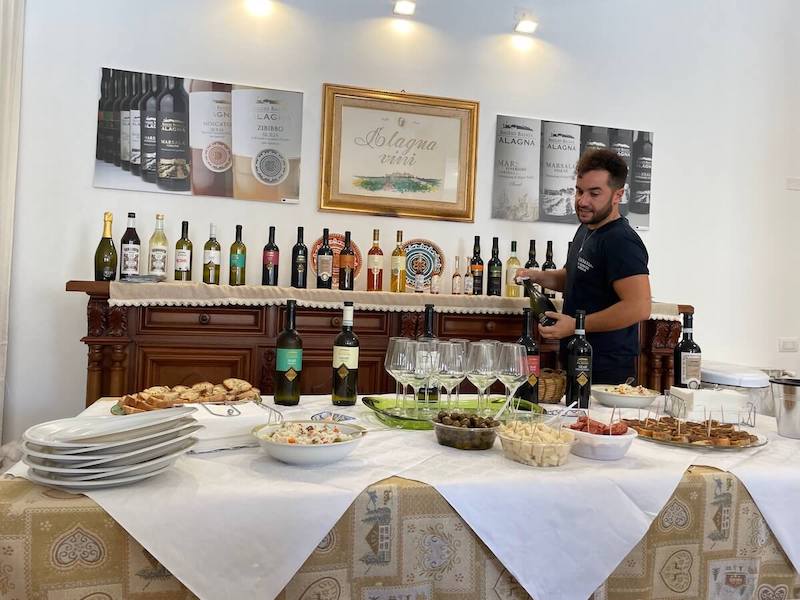
It would be rude to visit the Trapani-Marsala area and not sample its most famous export. Marsala is known abroad for its fortified wine, both sweet and dry, made by adding brandy and cooked grape must to white wine from native grape varieties. The result has a similar taste profile to Madeira.
But if you’re not keen on fortified wines don’t worry, they produce plenty of other wines too (I don’t necessarily recommend trying them all in one go like I did!)
There are numerous wineries and cellars in the area that you can visit for a tasting such as Vini Alagna (pictured above), Cantine Florio, Donnafugata, and Cantine Pellegrino. It’s a perfect combination with visiting the salt flats for a true appreciation of how your salt is made – I recommend Stagnone Nature Reserve where you can visit a museum or hop on a boat to Mozia Island.
If you’re interested in Phoenician history then Mozia Island and the Museo Archeologico Baglio Anselmi in Marsala are both worth a visit.
Vineyards run right up to the sea here and it’s also a popular area for villas.
There are beautiful historic towns to explore
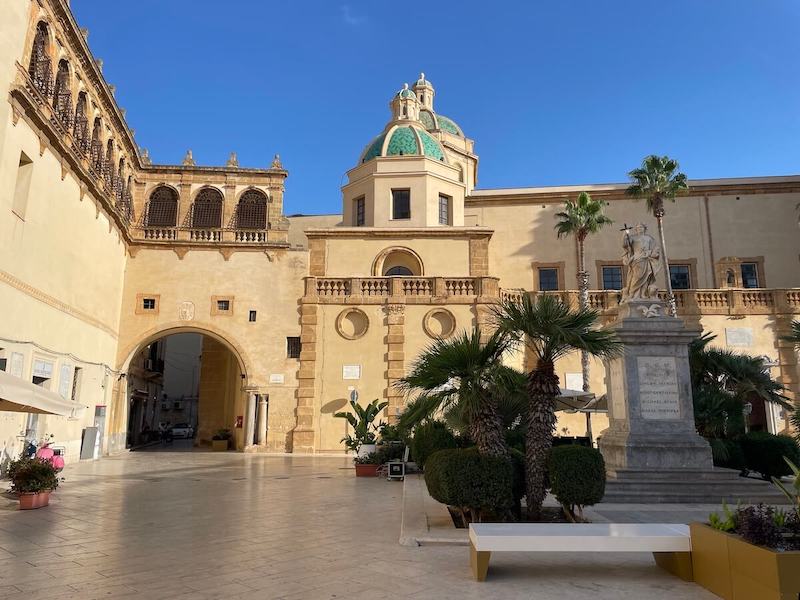
If you enjoy a wander around an atmospheric old town then pencil in visits to Marsala, Mazara del Vallo, and Sciacca.
The architecture here is dominated by sandstone and a strong Arab heritage. Mazara del Vallo even has a small kasbah with ornate doors that could belong in Tunis. There’s still a large North African community in Marzara.
This is also where you’ll find one of Italy’s largest deep-sea fishing fleets – the seafood here is impeccable. The local speciality is gambero rosso (red prawns) which are often eaten raw due to their high quality (and are also at the heart of a few controversies around territory and sustainability). The backstreets are a wonderful place to come for dinner without the crazy crowds and mediocre food of Sicily’s tourist hotspots.
Further along the coast is Sciacca, another fishing town where you can also take to its thermal baths which were created by the Romans.
Read more:
Where to Stay in Sicily: Ultimate Beach Resort Guide
10 Most Beautiful Beaches in Sicily
Image credits: Erice © dudlajzov / Adobe Stock
All other images © The Mediterranean Traveller